Understand your form of dizziness
We are a specialised primary-care physiotherapy practice for the diagnosis and treatment of dizziness and balance complaints.
Does everything spin around you? Do you feel light-headed or unsteady? Do you struggle to walk, get blurred vision when moving, or have symptoms in busy environments? Dizziness and balance problems can show up in many ways and have different causes.
That is why we start with a thorough and careful assessment. We map out your symptoms and how your balance system works. We then discuss the most likely cause and which treatment or next step suits you best.
Together we look for the cause of your dizziness and the right way forward.
2000+
Patients helped
5
Specialists
Investigating dizziness
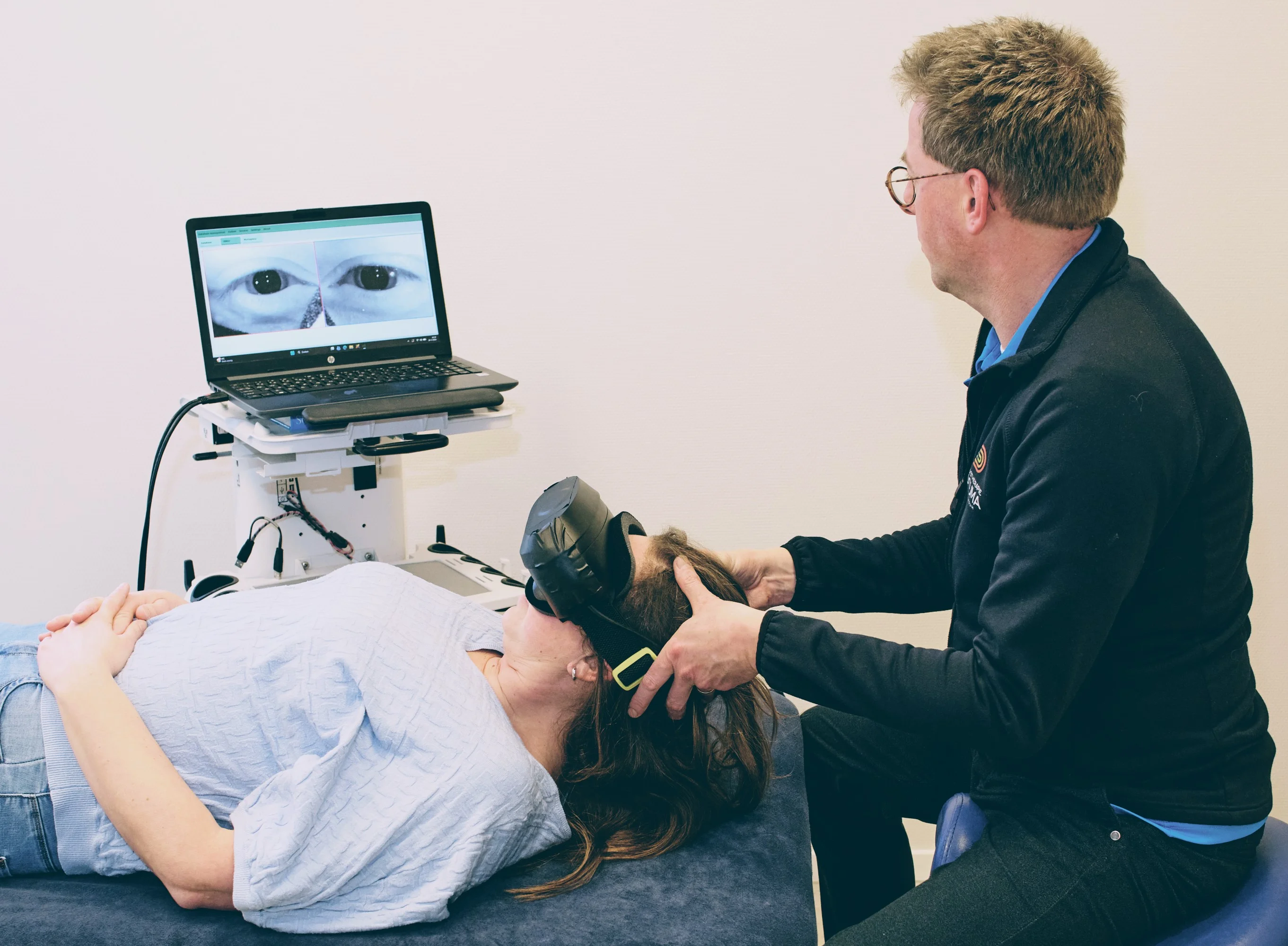
During the first appointment we do a thorough assessment that is tailored to your symptoms. This can include looking at eye movements, how your balance system works, balance, gait, neck function and possible circulatory factors such as changes in blood pressure when standing up.
If needed, the assessment can be carried out with aids such as Frenzel goggles, a Video Frenzel or video nystagmography (VNG).
Common conditions behind dizziness
Not every type of dizziness is treated the same way. That is why it is important to carefully find out what is causing your symptoms.
BPPV
Benign Paroxysmal Positional Vertigo
BPPV is one of the most common causes of rotational vertigo. Complaints are usually triggered by specific head movements and last a short time. Although the symptoms can be intense, BPPV can usually be treated effectively.
CANVAS syndrome
Rare disorder of balance, nerves and the cerebellum
CANVAS syndrome is a rare, slowly progressive neurological disorder in which both balance organs, the sensory nerves and the cerebellum can be affected. It mainly causes problems with balance, walking and keeping the image stable during movement.
Cervicogenic dizziness
Cervicogenic dizziness involves a light-headed or unstable feeling that may be related to neck problems. This usually does not involve true rotational vertigo from the vestibular organ.
Hyperventilation
Hyperventilation or dysfunctional breathing can cause various symptoms, including a light-headed feeling, instability, or dizziness. These symptoms are related to changes in breathing and the level of carbon dioxide in the blood.
Meniere's Disease
Meniere's disease is an inner ear disorder that can cause episodes of spinning vertigo, fluctuating hearing loss, and tinnitus. Symptoms occur in attacks that may last several hours.
Orthostatic hypotension
Orthostatic hypotension is a condition in which blood pressure drops when standing up from a lying or sitting position. This can temporarily reduce blood flow to the brain, leading to dizziness or a light-headed feeling.
POTS
Postural Orthostatic Tachycardia Syndrome
POTS stands for Postural Orthostatic Tachycardia Syndrome. In this condition, the body responds differently to standing upright, which can cause symptoms such as dizziness, palpitations, and fatigue.
PPPD
Persistent Postural-Perceptual Dizziness
PPPD is a condition in which people experience long-term dizziness or instability. The symptoms are usually present daily, often worsen when standing or walking, and can persist for months.
Presbyvestibulopathy
Age-related dizziness
Presbyvestibulopathy is an age-related decline in the function of the balance system. This can lead to symptoms such as instability, unsteady walking, or a light-headed feeling, especially during movement.
SCDS
Superior Canal Dehiscence Syndrome
SCDS is an inner ear condition in which a small opening in the bone above one of the semicircular canals is present. This can cause symptoms such as dizziness from sound, pressure changes, or certain head movements.
Vestibular hypofunction
Reduced function of one or both vestibular organs
With vestibular hypofunction, one or both vestibular organs function less well. This can cause complaints such as instability while walking, blurred vision during head movements and uncertainty in busy environments.
Vestibular migraine
Vestibular migraine is a form of migraine in which dizziness is a prominent symptom, with or without headache. Symptoms can range from a light-headed feeling to severe spinning vertigo.
Vestibular neuritis
Vestibular neuritis is a condition in which the vestibular organ suddenly functions less well on one side. This often causes a severe attack of rotational vertigo that can last for several days.
Vestibular paroxysmia
Vestibular paroxysmia is a condition in which short, repeated attacks of dizziness can occur. The attacks usually last seconds to minutes and can occur several times a day.
From symptom to the right help
Dizziness is not a symptom that develops the same way in everyone. That is why we look step by step at your symptoms, possible causes and the right next step.
Mapping out your symptoms
During the first appointment we take the time to really understand your symptoms. We discuss when the dizziness starts, how long the symptoms last, what triggers them and how they affect your day-to-day life.
Focused assessment
We then do an assessment that is tailored to your symptoms. We can look at eye movements, the balance system, balance, gait, neck function and changes in blood pressure when standing up.
Explanation and the right next step
After the assessment we discuss what the findings mean and what is the most likely cause of your symptoms. When treatment is possible we put together a suitable treatment plan. This can, for example, include vestibular rehabilitation, balance training, gaze-stabilisation training, habituation exercises or treatment of BPPV with specific repositioning manoeuvres.
Do you recognise these symptoms?
Dizziness can feel different ways. Some people have short attacks of spinning vertigo, while others mainly feel light, floaty or unsteady.
Common symptoms are:
- spinning vertigo
- dizzy when turning over in bed
- unsteadiness when walking
- blurred vision when moving your head
- motion sensitivity
- dizziness in busy environments
- unsteady walking or balance problems
- a light feeling in your head


Have your dizziness investigated
Would you like to find out where your dizziness or balance symptoms come from? Then get in touch with us to make an appointment at Duizeligheid.nl in Hilversum.
During the first appointment we carefully map out your symptoms and discuss which treatment or next step is most suitable.
Frequently asked questions about dizziness
From investigation to treatment
Because dizziness can have several causes, it is important to first carefully investigate where your symptoms come from. In our practice we do a thorough assessment of the possible causes of dizziness and balance problems. Based on the investigation we discuss what is most likely to be causing your symptoms and which treatment or next step is most suitable. If necessary we get in touch with your GP, ENT specialist and/or neurologist to consult or to refer you for further investigation.