
Examination for dizziness
Dizziness complaints can have different causes. Sometimes the cause lies in the vestibular system, but other systems in the body may also play a role.
That is why the process usually starts with a thorough examination. During the first consultation, we take time to carefully map your complaints.
An examination tailored to your complaints
The examination consists of an in-depth conversation and a physical examination tailored to your complaints. Not every part of the examination is needed for every patient.
Based on your story, we determine which examinations are most useful. The aim is to understand as precisely as possible how your complaints develop and what possible direction further assessment or treatment may take.

A detailed conversation about your complaints
The examination starts with a detailed conversation about your complaints. This is also called taking a medical history.
When mapping dizziness complaints, we often use a structured way of asking questions. This is known as the SO STONED principle. It helps important characteristics of dizziness to be assessed systematically.
In addition to these questions, we also look at previous episodes of dizziness, medication use, other medical conditions and factors such as stress, fatigue or a recent illness.
Which characteristics are discussed?
With the SO STONED principle, important characteristics of dizziness are discussed step by step. The questions help to carefully map the complaint pattern; they are not a diagnosis in themselves.
S — Symptoms
What complaints do you experience exactly?
For example spinning dizziness, a light-headed feeling, instability or motion sensitivity.
O — Often
How often do the complaints occur?
We discuss how often the complaints occur and whether a pattern can be recognized.
S — Since
Since when have the complaints been present?
We discuss when the complaints started and how the onset developed.
T — Trigger
What triggers the complaints?
For example turning in bed, standing up, walking or moving the head.
O — Otological symptoms
Are there ear-related complaints?
Such as hearing loss, tinnitus or a feeling of fullness in the ear.
N — Neurological symptoms
Are there neurological complaints?
Such as double vision, speech problems, sensory disturbances or coordination problems. This may be a reason for further assessment.
E — Evolution
How do the complaints develop over time?
We discuss how the complaints have changed over time.
D — Duration
How long do attacks last?
We ask how long the dizziness attacks or complaints last.
Examination of eye movements and the vestibular system
The vestibular system works closely with the eyes. That is why we examine different eye movements. These can provide important information about how the vestibular system is functioning.
During this examination, the following elements may be assessed, among others:
- facial nerve function
- eye-following movements (smooth pursuit)
- gaze shifts (saccades)
- gaze stabilization
- convergence and divergence
- fixation suppression
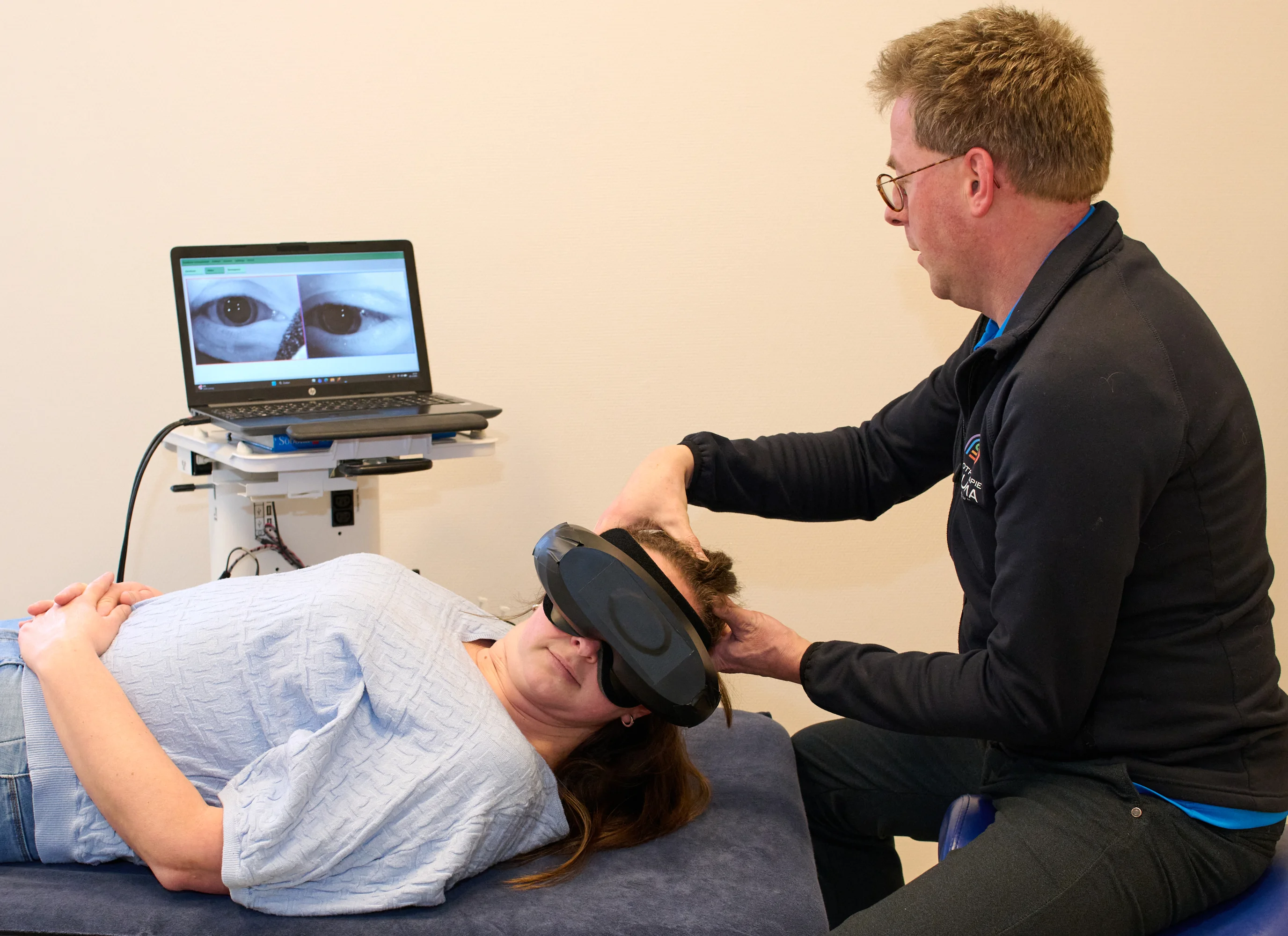
How well does the reflex between the vestibular organ and the eyes work?
The Head Impulse Test is used to examine how well the vestibular organ works. During this test, we ask you to look at a fixed point. The head is then moved briefly and quickly a small distance to the left or right.
Normally, the vestibular organ and the eyes work together through a reflex that keeps the eyes directed at the fixation point. This is called the vestibulo-ocular reflex.
When the vestibular organ is functioning less well, the eyes may temporarily lose the fixation point. The eyes then make a quick corrective movement to find the point again. This can be an indication of reduced vestibular function.
The Head Impulse Test is often used in the assessment of vestibular-system disorders, such as vestibular hypofunction or vestibular neuritis. The meaning of the test should always be assessed in relation to the full examination.
What happens to vision and eye movements?
With some vestibular-system disorders, vision can become less stable during movement. People may notice, for example, that the image appears to ‘bounce’ or becomes blurred while walking or during head movements.
This can be assessed with a Dynamic Visual Acuity test. During this test, we look at whether vision changes when the head moves.
With some disorders of the vestibular organ, specific eye movements can occur. These are called nystagmus. The pattern of these eye movements can provide important information about the possible cause of dizziness.
During the examination, we may look at:
- spontaneous nystagmus with fixation
- spontaneous nystagmus without fixation (gaze evoked)
To assess eye movements more accurately, aids such as Frenzel goggles, Video Frenzel or Video Nystagmography (VNG) may be used.
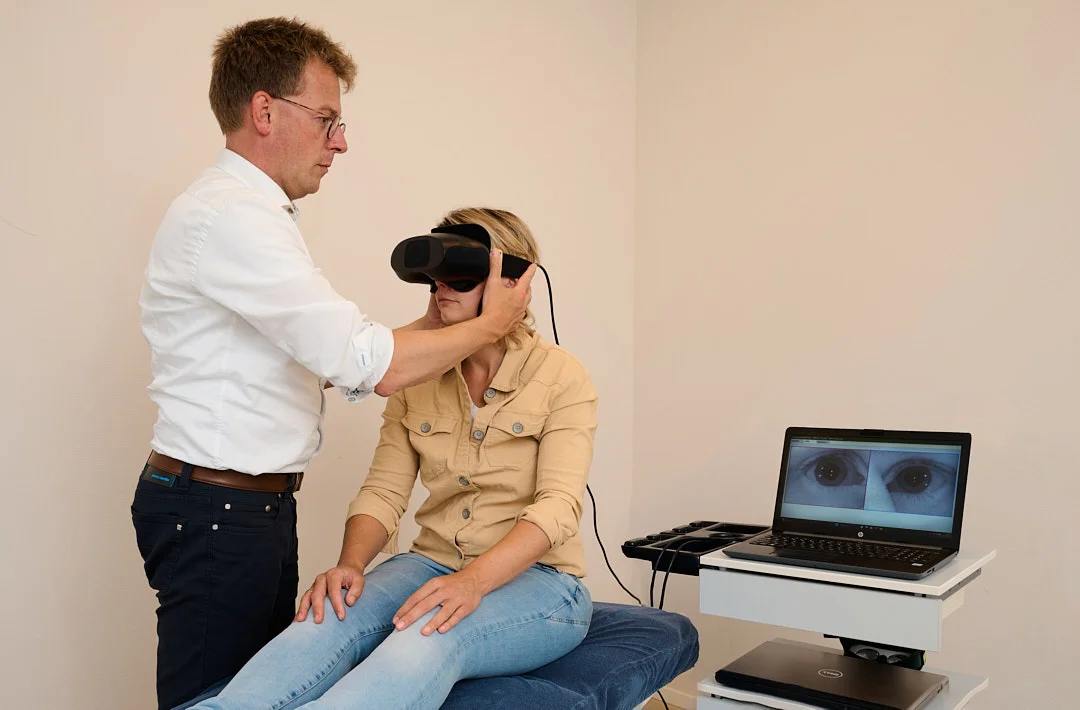
Examinations that may be used when needed
Not every part is needed for every patient. Based on your story and complaint pattern, we determine which examinations are most useful.
Positional testing for spinning dizziness
Assessment for BPPV
When the complaints fit positional dizziness, we may check whether certain head positions provoke dizziness and specific eye movements.
Balance assessment
Standing, walking and coordination
Balance and coordination can be assessed with tests that look at how stable someone is when standing and walking.
Neck examination
Mobility and muscle tension
In some people, neck complaints may play a role in dizziness complaints or instability. Neck complaints can also develop secondarily because someone starts moving the head differently.
Blood pressure and circulation
Lying and standing position
In some situations, dizziness may be related to changes in blood pressure, for example when standing up. If needed, blood pressure can be measured while lying down and standing.
Which tests may be used in positional and balance assessment?
For positional complaints, the following positional tests may be used, among others:
- Dix-Hallpike left
- Dix-Hallpike right
- Supine roll left
- Supine roll right
- Deep hanging test
For balance and coordination, the following tests may be used, among others:
- Romberg test
- finger-to-nose test
- finger-to-finger test
- tandem gait
- gait-pattern analysis
When there are indications of circulatory causes, further assessment through the GP may be needed.
Discussing findings and next steps
After the examination, the findings are discussed with you. Sometimes a clear cause of the complaints can be identified based on the examination. In other situations, the examination may provide indications for a possible diagnosis.
Discussing the findings
We discuss what stood out during the conversation and physical examination, and what this may mean.
Treatment or advice
When treatment is possible, we discuss which treatment seems most suitable. In some situations, additional assessment through the GP or a specialist is needed.
Report to the referrer
If you came through a referrer, we send a report of the examination back when the referrer has a ZorgMail address.

Would you like your dizziness complaints to be examined?
During a first consultation, we take time to map your complaints and determine which examination is useful. An appointment does not replace urgent medical assessment; discuss severe or rapidly changing complaints with your doctor or specialist.